

Colour — how white it is.
Diamonds are graded for colour from D (completely colourless) to Z (light yellow). Our default recommendation sits at the top of the scale — D, E or F — where there's no detectable tint to the naked eye in any setting.
G is acceptable in the right cut stone, where the cut is doing the optical work. We can source any colour on request.
Colour is graded by what's not there.
The colour grade measures the absence of yellow tint in a diamond. D is the absence of any colour — completely colourless. Z is a faint yellow that's visible to the naked eye.
Between those extremes, the differences are graded but real. D, E and F are colourless — there's no detectable tint, in any light, from any angle. G is the first of the near-colourless grades, where a well-cut stone can still read white in a setting. From H onwards, a soft warmth begins to enter the stone, becoming visibly yellow by K and unmistakably so by N.
The colour grade scale
D to Z, at a glance.
The GIA colour scale runs from D (completely colourless) through Z (light yellow). The groupings below mark where the eye starts to register warmth — and where we typically draw the line on what we recommend.
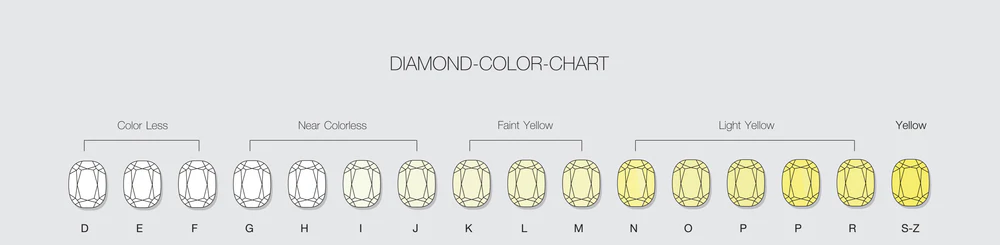
Once the eye knows what colourless looks like, it doesn't forget.
D, E and F are the colourless grades. There is no detectable tint in the stone, viewed from any angle, in any light — it reads as pure white. This is where we begin every recommendation. A colourless diamond never looks warm against a white setting, never looks dull against skin, and never starts to feel "off" five years later under a different light than the one you bought it in.
G is the first of the near-colourless grades. In a well-cut stone, where the cut is doing the optical work, a G can sit beautifully in a ring without revealing its grade to the eye. We'll recommend G when the cut quality is strong and the client prefers the value — but it's a judgement call on the individual stone, not a default.
Below G, the warmth becomes increasingly perceptible. H through J are near-colourless on paper but begin to show a soft warmth in white settings. K and below show a visible yellow tone. We can source any of these on request — some clients prefer the antique warmth of a J or K in a yellow gold setting — but they sit outside our default recommendation.
Metal affects perceived colour.
The metal surrounding a diamond influences how its colour reads. White metals (platinum, white gold) demand the highest colour grade because there's nowhere for warmth to hide. Yellow and rose gold absorb warmth into the metal, which means lower grades read whiter than they actually are.
If you only remember three things
- We default to D, E or F. Truly colourless is the standard we ask of every diamond we set, regardless of setting metal.
- G is acceptable in the right stone. When the cut is strong and the client prefers the value, a G can sit beautifully — but it's a per-stone judgement, not a starting point.
- We can source any colour. Warmer grades (H onwards) are available on request, particularly for yellow or rose gold settings where the warmth flatters the metal.
Search colourless diamonds in your budget.
Filter hundreds of thousands of certified diamonds by colour grade, shape and price. We default to D, E and F — and can source any grade on request.