

Clarity — how clean it is.
Inclusions are nature's fingerprints in a diamond — tiny internal characteristics formed during the stone's creation. Clarity grades measure how many, how large, and how visible those inclusions are.
For natural diamonds, we recommend VS1, VS2, and eye-clean SI1 — the sweet spot where inclusions are invisible to the naked eye. For lab diamonds, we recommend VS1 and above.
Clarity is what the loupe finds.
Gemmologists grade clarity by examining the stone under 10× magnification — a level of detail your naked eye will never replicate in everyday wear. The scale runs from Flawless (no inclusions visible under 10×) to Included (inclusions visible without magnification).
The catch: most of that scale is invisible to the unaided eye. A VS1 stone has inclusions, but you'd need a microscope to see them. SI1 starts to show inclusions to a trained eye under good light. Only I-grade stones show inclusions to a casual viewer.
The clarity grade scale
FL to I3, at a glance.
The chart below shows the five clarity bands as they appear under 10× magnification — the same magnification used by gemmologists to assign the grade. To the naked eye, anything in the VS band and most SI1 stones look identical.
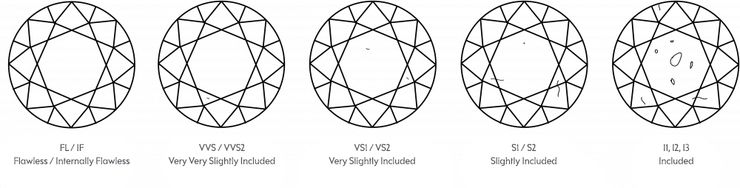
The grade is set under magnification.
Clarity is determined by examining the loose stone under 10× magnification — a level of detail no human eye will ever replicate in everyday wear. Flawless and Internally Flawless stones have no inclusions even under that magnification; VVS stones have inclusions so small that a trained gemmologist needs to hunt for them.
For most clients, that distinction is invisible and not worth paying for. VS grades have inclusions — they're just impossible to see without a loupe. SI1 stones often look identical, but contain inclusions that could be visible if poorly placed. This is where our eye-clean inspection matters: we screen every SI1 individually to ensure the inclusions sit where the cut and setting will hide them.
SI2 and below tend to show inclusions to the naked eye — black carbon spots, feathers, or clouds that catch your attention before the sparkle does. We don't recommend going there.
Our recommendations differ by origin.
Clarity pricing behaves differently for natural and lab-grown diamonds. With natural stones, every grade you step up adds a meaningful premium — so VS and eye-clean SI1 represent the best value. With lab stones, higher clarity grades carry a much smaller premium, so we typically recommend pushing the floor up to VS1.
The sweet spot for natural stones. Inclusions present but invisible to the naked eye. Stepping up to VVS or IF carries a steep premium for clarity only a gemmologist will ever see. We hand-inspect every SI1 to confirm it's eye-clean before recommending it.
Lab clarity premiums are much smaller than natural, so the case for stepping down to SI weakens. We recommend VS1 as the floor on lab stones — the price gap to VVS is modest, and the certainty of a fully eye-clean stone is worth it.
If you only remember three things
- Natural — aim VS1, VS2, or eye-clean SI1. The maths peaks here. Anything cleaner is paying for what only a loupe can see; anything dirtier risks visible inclusions.
- Lab — aim VS1 and above. Smaller clarity premiums mean it's worth stepping up. We won't go below VS1 on lab.
- Always hand-inspect SI stones. Two SI1 stones can read completely differently depending on where the inclusions sit. We screen every shortlisted SI for eye-clean placement before showing it to you.
Search eye-clean diamonds in your budget.
Filter hundreds of thousands of certified diamonds by clarity grade, shape and price. Every shortlisted stone is hand-inspected under magnification before you commit.