

Carat — how big it weighs.
Carat is a unit of weight, not size — but the two correlate closely. One carat equals 0.2 grams (200 milligrams). A 1.0ct round brilliant measures about 6.5mm across the table.
Our advice differs by stone type. On natural diamonds we recommend setting a budget and spending to it — the price-per-carat curve climbs sharply once you cross 1, 1.5, and 2 carats. On lab diamonds the opposite applies: stay practical rather than chase size.
Bigger isn't always better value.
Diamonds are priced per carat — but the per-carat price increases dramatically as you go up in size. A 2.0ct stone costs roughly 4× a 1.0ct stone of the same grade, not 2×. This is because larger diamonds are exponentially rarer in nature.
Add to that the market's premium for round-number weights. A 2.0ct stone commands a 20–30% premium over a 1.9ct stone — for a difference in diameter of less than 0.2mm. We use these "shy" weights constantly to give clients more diamond for their dollar.
Weight, translated to size.
Carat is weight, but on the hand you see size. The chart below shows how round brilliants scale from a quarter carat through three carats — the diameter difference between popular weights is smaller than most people expect, which is why a 0.90ct can sit on a finger almost identically to a 1.00ct.
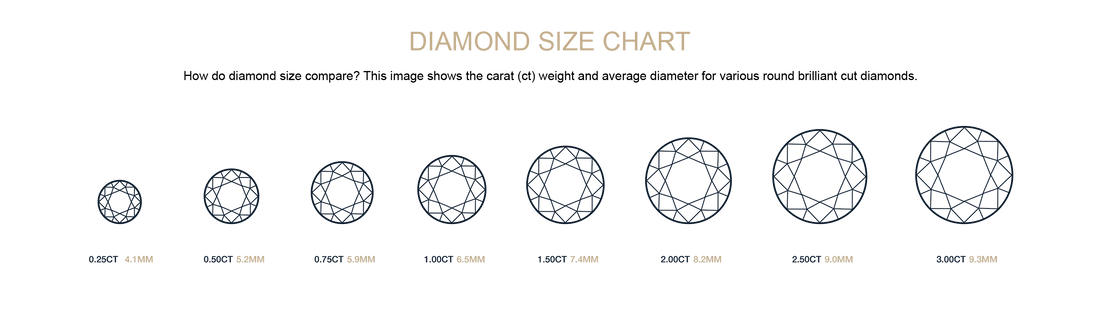
The "shy" weights save thousands.
The diamond market prices in steps. A 1.00ct stone commands a 15–20% premium over a 0.90ct stone for less than 0.2mm of extra diameter — a difference no one will ever measure on your hand. We use these shy weights constantly to give clients more stone for their budget, or to redirect the saving into cut, colour, or clarity.
~6.2mm vs ~6.5mm. Less than 0.3mm of diameter difference. Indistinguishable on the hand.
~7.2mm vs ~7.4mm. The 1.5ct threshold is one of the steepest jumps on the curve.
~8.0mm vs ~8.2mm. Below the 2-carat threshold the per-carat price drops noticeably.
Different stone, different rules.
Carat is the C where natural and lab diamonds split most sharply on strategy. Natural prices climb exponentially with weight; lab prices climb almost linearly. That changes everything about how we recommend you spend.
Set a budget. Spend to it.
Once you cross 1, 1.5, and 2 carats, the per-carat price doesn't just step — it jumps. Pushing for the next round number on a natural can double your spend for a quarter-millimetre more diameter. We help clients find the largest, best-cut stone inside their actual budget rather than chase a number on a certificate.
Stay practical. ~4ct is the sweet spot.
Lab pricing makes larger stones genuinely accessible — but past a certain size the ring becomes impractical to wear daily. Around four carats is where we see the best balance of presence and wearability. We do five, six, and beyond when a client wants it — but we'll usually flag where the diminishing returns start.
Some shapes wear larger.
A 1-carat round brilliant and a 1-carat oval weigh the same on the scale — but the oval looks visibly larger on the hand. Elongated cuts spread the weight across a longer face, so they cover more finger for the same carat. Compact cuts like the princess or cushion concentrate weight downward into the pavilion, so they show less face-up.
Below are typical face-up dimensions for a 1.00ct stone, by shape.
If you only remember four things
- Match the strategy to the stone. On natural diamonds, set a budget and spend to it — prices climb steeply at the 1, 1.5 and 2-carat thresholds. On lab, stay practical rather than chase size; around 4 carats is the sweet spot.
- Buy shy of the threshold. A 0.90ct, 1.40ct, or 1.90ct reads identically to the round number on the hand — and costs 15–30% less per carat. Especially valuable on naturals.
- Shape changes the perceived size. An elongated cut (oval, pear, marquise) at the same carat will look significantly larger than a round or princess. Choose for finger coverage if that's the priority.
- Don't sacrifice cut for carat. A well-cut 1.0ct sparkles more brightly than a dull 1.5ct — and reads larger because the light return makes it appear bigger.
Find your carat at the right price.
Filter hundreds of thousands of certified diamonds by carat, shape and price. We'll point out the shy-weight options that save thousands without changing the look on the hand.